Showing posts with label history. Show all posts

Wednesday, November 20, 2013

A Little Carmel and San Francisco History

As I mentioned a couple of posts ago, I'm participating in this year's NANOWRIMO contest and my novel is moving along. 50,000 words in 30 days requires consistency and the ability to scream down the "inner editor" who pops up to tell you that you're writing rubbish.  After all, the idea is to produce a very rough draft of a novel during the month of November.  I successfully passed the half way point, both calendar-wise and word count-wise.  Now I need to pour it on for the last half of the book.  My novel is historical fiction, set during the turn of the 20th century in San Francisco and Carmel.  This requires some research on my part -- how did they get around at that time? What forms of communication did they have?  How did they dress?  Carmel has always been rather Bohemian, a place for artists and writers to gather.  And of course, the great earthquake of San Francisco occurred in 1906, and it will have a role in my novel.

Ocean Avenue is the main drag leading from Highway 1, through downtown Carmel, and ending at the Pacific Ocean.  We lived in Carmel for a time, in a house tucked in the copse of trees near the top left of the photo below.  I have walked from our house there, down Ocean Avenue to the stores.  It's lovely, but a bit steep going home.  This photo is from 1905.  Note the horse and buggy. 

I took the photo below earlier this year.  It is the same section of Ocean Avenue, but looking from the opposite direction, in other words looking down the hill rather than up the hill.  What struck me were the trees they planted down the middle of Ocean Avenue!  They have grown majestically.  The first tree on the other side of the bell you see below is used as the town's Christmas tree each year.  It has been a tradition in our family to go to the town Christmas Tree Lighting, and we have attended Carmel's and Monterey's in years past. 
As any San Franciscan knows, while the quake created extensive damage, it was the fires that broke out afterwards that really caused major destruction.  In doing my research, I found a map that showed how far reaching the fire extended.  Can you find the Ferry Building toward the bottom of the map with the clock tower?  It is the same clock tower I took a picture of in my last post on November 12th.
Besides serving as a ferry station, the Ferry Building now houses an active marketplace, restaurants, and office spaces.  It survived the Great Earthquake of 1906.

It is always interesting to find familiar places on old maps, like where my daughters currently live and work in the city.  San Francisco. Monterey. and Carmel have such rich histories and writing about them reminds me of why I love living here, earthquakes and all.

Saturday, October 20, 2012

Wonderful Williamsburg!

Aye-yie-yie!  Imagine returning from a fabulous family vacation, falling right into charity committee work, click-click-clicking into a new school year -- everything suddenly seeming like its all in fast motion.  Sums up my life for the last two months.  So let's rewind here and go back to my last post -- yes, back into hot, sultry summer days, into that rental car driving from the blue waters of North Carolina's Outer Banks into Virginia....  Back, back, back to hot summer days, radio blaring, my daughters and I taking photos out the car windows as we take in the scenery.  And then we pull into Colonial Williamsburg!

Lunch at a town tavern was simple fare, but satisfying. It was mid-summer hot and we were thirsty!
It's interesting that there are actually a few private citizens living in some of the houses in this non-drivable historic area of town.
We watched artisians and laborers at work....
 Shopkeepers....
 and soldiers in the military encampment....
We even listened as Patrick Henry and other speakers presented their political views.
The courthouse was the site where Benjamin Waller read the Declaration of Independence on July 25, 1776, after it arrived from Philadephia.  Such history resonates through these walls and on these steps!.   
 The Governor's Palace below is a strong reminder that we were once under the rule of the British Monarchy.
  
The wig room....
 
 Lavish linens on the canopied beds....
 
 
 Swords lined the entry hall of the Governor's Palace...
 The flag during this period bore British and eventual USA symbols.

Being the history buffs that we are, this was a a much loved and memorable stop on our road trip north!

Sunday, October 2, 2011

Dressing from the Inside Out in Revolutionary Times


Yesterday I attended a district Daughters of the American Revolution program in Cupertino.  Prospective member and new friend Charlene rode up with me and we had a great time, chatting and laughing all the way there and back, but the highlight of our day was the terrific program.  Feather Tippetts (yes, that's her name!) historical costume designer, demonstrated how women back in Revolutionary War times dressed, from the inside out. She makes sure that all of her clothing is historically accurate.  To read more about her work check out this article in the Mercury News.  Here is a little snippet that describes her work:

With a French Milliner as her maternal grandmother it’s hardly surprising that costume design and creation are a passion for Feather. The owner and principal designer of Grand Gestures Historical Costume, she creates garments as historically accurate as possible. Her clients include Impersonators, Re-enactors, and Interpretive Speakers at Historical Sites. Frequently called upon as a speaker and consultant on historical clothing for museums, educational institutions, and private clubs, she also leads workshops on design and construction for students focusing on historical costume.

Beginning with a linen shift, stays filled with reeds are laced on,  These stays provide good posture and make it impossible to slouch. They are different than corsets, which did not come along until later in history.
 Next come the petticoats -- women usually wore two or three of them -- and a white cloth that covers the neck as women wanted to protect their skin from the sun.
Pockets were made, some simple and some decorative, some small and some large, and tied around the waist under the petticoats. Girls sometimes embroidered fancy pockets as gifts for one another.  Petticoats and gowns had slits in the sides so that women could reach into their pockets.   Women used them in the same way we do purses today -- they may hold a fan, a writing utensil, coins, etc.  Now the old nursery rhyme makes more sense as you can imagine walking along and having the ties come undone on your pocket:
Lucy Locket lost her pocket,  Kitty Fisher found it,
Not a penny was there in it, only ribbon round it.
The final flower print petticoat and then the day gown were put on.  The day gown only had a skirt on the sides and back so the petticoat showed in the front.  Therefore, women could change the look of their clothes by wearing a different petticoat as the top petticoat.
Back of day gown.  This is what a woman would wear at home, out shopping, around the village....

Back to basic shift and stays, to begin dressing for a ball.  The first step is to tie on panniers -- these consisted of hoop pockets, created with reeds bent by steam.  All women could sew.  Some women made their own clothes and some had maids that did the sewing.
Next a petticoat was placed over the panniers.  The idea was that the more cloth you could use and display in your gown, the wealthier your husband was, hence the additional width provided by the panniers.
 The top of the gown (with side and back skirt) was put on and laced.
 
Next a stomacher was selected.  The stomacher was pinned over the chest and upper tummy area.  They didn't use safety pins back then, they used straight pins which were quite pricey.
 A gown top was chosen -- look at the lovely detail:
This was called a transition gown -- the front was the flat 'monobust' look from Britain, but the back was full and of the fashion of France.  The French influence on women's clothing was taking hold.
Taking her final bow with an ostrich feather in her hair.  The history Feather shared was as wonderful as her costume.

Sunday, February 22, 2009

Bringing History to Life

I'm a descendant of American Patriots, men who fought in the American Revolution and their loved ones who stood by them. They really went out on a limb for freedom, and it is humbling to imagine them taking up arms and standing firm for independence. There is a wonderful television miniseries/documentary on the American Revolution I've recorded, and I'm always amazed at how cool, calm, and collected Geo. Washington comes across in the series. "Father of our country" is a fitting accolade for him. I'm a member of the DAR, which usually evokes images of stuffy, older, ultra-conservative ladies sipping tea. But in reality it is an organization of active, committed women, working together to make a difference. It's a great nonprofit, striving to promote education, historic preservation, and patriotism. Evolving through the years, it is has been interesting to watch it "go green", help schools, look out for our veterans and soldiers (whether members believe in the war, or not, we look out for our own). I'm proud to be a member and honor my ancestors' memories for sidling out on that tree branch.

Yesterday we had our monthly meeting and honored the 200th birthday of President Abraham Lincoln with a guest speaker ~ Col. Isaiah Turner. Col. Turner gave a first hand account of what it was like to be a solider in the Civil War. He talked about how a lot of the Northern boys looked like the Southern boys -- young, 18, 19, 20 years old. He talked about the hardships, the battles of Bull Run, Gettysburg, Fredericksburg, and the surrender of Gen. Lee in 1865. He also described the life of soliders when not in battle, including gambling, louse races (picking lice off their jackets and putting them on their plates to race), and how the song "Home Sweet Home" was banned because it made the soldiers too homesick and they always ended up with desserters. He ended by talking about how the Civil War was the deadliest war in US history, with more than 620,000 dying, and reflected on what that war meant and its impact on our country today.


It's always made me curious -- what would possess a grown man to don a uniform from a by-gone era and participate in re-enactments, as our guest speaker does? He explained he is concerned about how poorly our American students perform in history. Do they really care what our country has been through? Is it all just blah-blah-blah in their ears, like war stories told one time too many? He believes by bringing history to life, he can help people understand and remember our history more poignantly. So a sharp salute to Col. Isaiah Turner. He earned our respect yesterday for what he is attempting.

Sunday, December 14, 2008

Christmas in the Adobes

Feeling very much like a domestic goddess today (a rarity, let me tell you), I thought I would take a break from the cooking, baking, gift wrapping, and sewing (yes, you read that right) to share pictures of the annual Christmas in the Adobes. This beloved event is basically a candlelight walking tour through downtown Monterey. We went last Thursday night, as rain was forecast for Saturday night, and it was ideal. The museums were open, unique gifts could be purchased in the "first store", and apple cider, Mexican cocoa, and Christmas cookies kept our energy up for the brisk walk. On the patios, musicians played a variety of interesting instruments from Monterey's early days. There are almost two dozen places that you can visit on the route. We learned more about California's history, and came home even more in the Christmas spirit!

The Christmas tree in the Pacific House museum:

The museum's bear -- the bear, of course, is an important California symbol and appears on our State flag:


The Boston Store was the first store in the state and boasts the first safe (all that gold from the gold rush had to go somewhere). You can still buy old-fashioned ornaments, embroidered handkerchiefs, books on our history, and many other items there:


The Merritt House was decorated beautifully:

The lawn at the Merritt House:

Below is California's First Theater. This is hard to see at night as it is an old wooden structure. The doorways are very short and you have to be careful not to hit your head entering.



This should look familiar! Colton Hall with the town Christmas Tree:


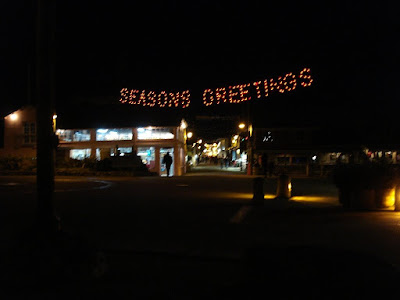
A downtown Monterey street aglow for Christmas:


The entrance to Fisherman's Wharf: